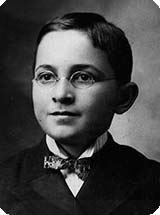
Harry S. Truman, the 33rd president of the United States, was born on May 8, 1884 in Lamar, Missouri. In 1890, the year the Little White House was built, the Trumans moved to Independence, Missouri.
His poor eyesight prevented Truman from participating in sports but led him to two of his greatest passions, reading and music. An avid reader, he was proud of the fact that he had read every book in the Independence Public Library. Truman was also a fine musician, playing the piano.
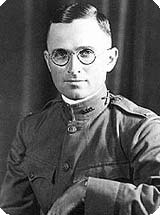
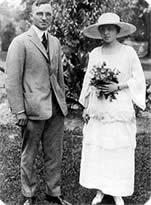
An excellent student, Truman’s parents were unable to afford college for Harry and his eyesight prevented him from attending West Point. Following his high school graduation in 1901, Truman worked at a variety of jobs including farming, oil drilling and banking. In 1917, with World War I in full force, Truman joined the Army. He served in France and left the army as a captain in May of 1919. One month later, he married Elizabeth Wallace.
Fun TRIVIA Fact
Did you know that Harry S. Truman actually had no middle name? His parents gave him the middle initial S to honor and please his grandfathers, Anderson Shipp Truman and Solomon Young. Since the S did not stand for a name, Harry didn’t use a period after it for most of his life. Soon after he was elected president, the editors of the Chicago Style Manual informed Truman that omitting a period after his middle initial was improper grammar and a bad example for America’s youth. From that moment on, the 33rd President signed his name Harry S. Truman or put all the letters in his name together as in Harrys Truman.
After failing in the haberdashery business, Truman ran for county judge (the title for a county commissioner) in Jackson County, MO. In 1924, he ran for re-election and lost, the only election he ever lost. In 1926 he was again elected judge, a post he held until 1934 when he ran for the U.S. Senate and won. During World War II, Senator Truman headed The Truman Committee that investigated wartime corruption and waste spending, saving the government between $10 and $15 billion, not to mention thousands of lives of servicemen. He remained in the Senate until President Franklin Roosevelt tapped him as his running mate for his fourth term in 1944.
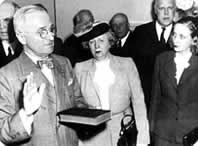
On April 12, 1945, less than three months as vice president, Harry S. Truman was sworn in as the 33rd President of the United States following the unexpected death of Roosevelt. Truman faced some of the most complex issues to ever face any world leader.
Internationally these decisions included the decision to drop the atomic bomb to end World War II, the daunting task of re-building both Europe and Japan, the changing of American foreign policy.
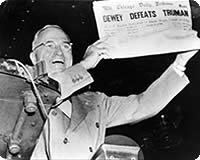
The creation of the North Atlantic Treaty Organization (NATO), the Central Intelligence Agency (CIA) and National Security Council (NSC), the recognition of the State of Israel, the response to the Cold War and our involvement in the Korean War were also decisions that Truman faced.
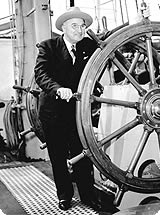
Domestic issues proved equally challenging with issues of labor unrest, expansion of the GI bill for returning veterans, a proposal for national health care and the issuing of four civil rights executive orders made Truman not particularly popular during his terms in office. Yet today, Truman is thought to be one of the best presidents in U.S. history.
On December 26, 1972, Harry S. Truman died in Kansas City, MO at the age of 88. In the year 2000, a C-Span Poll ranking of all U.S. Presidents was conducted by 58 presidential historians and scholars. Harry S. Truman ranked 5th behind Lincoln, Franklin D. Roosevelt, Washington and Theodore Roosevelt.
Give ‘Em Hell, Harry!
Have you ever heard of the famous one-man play about Harry Truman? Many folks know it well, but here’s a fun fact you may not know—in 2017, the play had a run in Wilmington, North Carolina and the lead role went to Clifton Daniel. Daniel, a part-time actor and the honorary chairman of the Truman Library Institute in Kansas City, Missouri, earned the role because of his ability to match Truman’s inflection with uncanny perfection. This gift seemed to come naturally to him, it didn’t hurt that he is Harry Truman’s grandson!
Undercover Truman?
These days a President of the United States, past or present, can’t go anywhere without the protection of the secret service. But things were different in the 1950s after Truman Census left office. On one occasion, Truman and his wife Bess decided they would take a drive across the country. Their plan, to enjoy a leisurely 19-day trip around the USA was not as relaxing as they envisioned. Everywhere they went, rest stops, diners and shops, they were greeted by folks who immediately recognized them and were curious about what they were doing and where they were going. The 33rd president even got pulled over for driving 55 in the fast lane on the ride home—luckily, no ticket was issued!
